


I’m Ellery Ng — Executive Communication & Confidence Coach
ICF Professional Certified Coach (PCC)
Newfield Certified Ontological Coach
Asia’s Certified Coach in Embodied Yoga Principles
How a More Practical Approach to Public Speaking in Singapore Can Help You Speak Confidently
Many public speaking coaches in Singapore focus on a controlled scenario: a prepared speech, a stage, a waiting audience. The emphasis is on rehearsed delivery – memorising your script, how to project your voice, when to gesture, how to stand, when to move. While these have their uses, what I help my clients with is the kind of public speaking that stems from your executive presence: your response to a senior leader’s impromptu question, the position you need to defend under pressure at a meeting, the sudden clarification asked of you in town hall… in other words, the unplanned moments where you need to speak with clarity and impact. Before finding me, many of my executive clients have tried training programmes, YouTube tutorials, and often, books on ‘body language’. Yet, they found the techniques they collected didn’t make a difference when they needed to speak up in group settings. A public speaking coach in Singapore who works on rehearsed stagecraft is solving a different problem. For the clients who work with me, the gap was never stagecraft. It was the ability to think clearly, speak coherently, and stay grounded in the unscripted, high-stakes moments that make up most of professional life. This is the practical approach to public speaking in Singapore that our coaching is built around – we focus on how you show up in the everyday interactions that shape your credibility.
Are these public speaking challenges familiar to you?
Scenario A: speaking up at the discussion

Your opinion is welling up in your chest; your idea has sparked in your mind. But nothing comes out of your mouth; your hand stays down. You feel yourself stiffen as your heart races. Your mind is frantically editing what to say while fending off what the others around the table might think of you. While deciding if it’s the right moment to speak up, the moment has actually passed you by, as the group moves on to another topic. Once again, your chance to shine has been buried under a barrage of anxious overthinking…
Scenario B: owning the presentation

You’ve memorized your script. You’ve rehearsed the talk. You’ve also lost sleep, leading up to this day when you’re due to address the audience. In the moment before you take the stage, your nervousness shoots up. Your heart races as you feel perspiration on your skin. You try to recite the sentences you painstakingly memorized as you deliberately avoid the judgmental gaze of the audience. Suddenly, someone asks you question; you struggle to answer becuase you did not expect this. And then, you lose track of what you’re supposed to say next. Feeling derailed, you cut your delivery short to get out of the spotlight as quickly as you can…
Has the gap between your knowledge and your confidence cost you recognition, influence… or even promotions?
What Does a Public Speaking Coach Do?
An ontologically-trained public speaking coach helps executives become clearer, more grounded and more persuasive by working not only on rehearsed stage deliveries, but also on the body, emotions and language patterns that shape how they show up under pressure. In my coaching expertise, we focus on impromptu workplace communication – in meetings, presentations, pitches, Q&A sessions and high-stakes discussions – where capable executives can lose credibility because of anxiety, overthinking or unhelpful bodily habits. Rather than relying on scripts or shallow ‘body language’, my ontological coaching gives you practical, sustainable ways to regulate pressure, organise your thoughts, assert your view and respond in real time. The goal is not just a confident exterior, but to actually build greater emotional capacity that’s portable across boardrooms, town halls, group conversations and everyday leadership moments. In other words, I help you embody executive presence – not just pull off polished performances.
What are you challenged with?
Mind going blank
Structuring your delivery
Asserting your opinions
Speaking up (at all)
Landing impact
Overthinking
Stage fright
Anxiety
These are the pain points of numerous clients in my coaching practice. The good news is: confidence in public speaking isn’t a personality trait — it’s something you can develop. My approach to public speaking coaching is what I call the Embodied Voice Approach: a practical, ontological method that helps you work with your body, emotions and language so you can stay clear, grounded and responsive under pressure. In this article, I’ll share why speaking anxiety happens, why common ‘quick tips’ are just band-aids, and how working with a public speaking coach in Singapore can support you in becoming more confident in the long term.

Yanee P.
“In presentations, I was able to overcome the anxiety & focus on communicating my message authentically, focusing on what I want to deliver. I have become less concerned about how I am perceived by others. My confidence has markedly improved as a result.”

COMPLIMENTARY PRE-CONSULT
Why Public Speaking Anxiety Happens (and How to Overcome It)
Feelings of anxiety and nervousness in high-stakes moments are not a sign of weakness — they’re a natural response in a healthy, functioning nervous system. Mentally, you genuinely care, as there’s something important at stake. Physiologically, your brain and nervous system interpret the situation as a form of threat. So they go into fight-or-flight, and you start experiencing anything from overthinking and a blank mind, to elevated heart rate and sweating.
For example, a director-level executive engaged me because she constantly found herself silent during meetings with sponsors, even though she had first-hand data about the rights and wrongs of the matters being discussed. The issue wasn’t authority or expertise, or whether she rehearsed the conversation (it was not practically possible anyway) — it was how her stories and her nervous system hijacked her voice.
This is exactly what I address when working as a public speaking coach in Singapore.

Dr. Lisa Feldman Barrett has long indicated that emotions are constructed by our body and brain together. This means that managing public speaking anxiety isn’t simply a mental endeavor, and it certainly isn’t just about positive thinking or raising your self-esteem. Anxiety – and confidence – come when you are congruent in your body and in your thoughts.
Dr. Lisa Feldman Barrett's Research Findings
"If I have a big change in the systems of my body, and I feel intensely unpleasant, my brain might make an instance of anxiety. It might make an instance of longing if I’m waiting for my lover or best friend or daughter to come home. So it’s not your reactions to the world — it’s the way your brain makes sense of the inner workings of your body in relation to the world." (Barrett, 2018)
💡 Meaning, your physicality is a huge part of how you access confidence during public speaking moments.
This is why I focus on helping you build awareness of your entire being – body, emotion and language – in my Embodied Voice Approach. Your voice is not just a sound or a script, but an embodied expression of how you are physically, emotionally and linguistically organised in the moment. When you work with me, I want you to not just be heard, but to be felt.
Why ‘Quick Tips’ for Public Speaking Don’t Stick (& How a Public Speaking Coach in Singapore Can Help)

- Over-rehearsing can make you look and sound robotic.
- Memorized scripts fall apart the moment you’re interrupted with an unexpected question.
- Tricks like imagining the audience in underwear may lower your tension, but they either have limited usage or easily distract you from your delivery.
That’s why many people still struggle with a lack of confidence in public speaking even after countless rehearsals, and self-help videos and books on ‘effective public speaking.’ The emotional faculties are involved, and they cannot be ignored.
A Client’s Success Story of Presentations & Public Speaking
“People with balls” would be the last thing you’d think of this client of mine, if you encountered her in the past. She sought me out because she was riddled with anxiety at the workplace. Even an unexpected “Hello, how are you” from a colleague would make her anxious. She suffered low confidence in her official duties whenever she had to facilitate meetings between different departments, or to formally present her views. The tension from the discussions and questioning often made her freeze.
Today, after coaching with me and actively practicing what she’s learnt, she has no issues with presenting and speaking up in the room. This embodied, felt sense of confidence was validated in the form of feedback from her CEO, as well as invitations to work with senior leader teams.
Her own words are captured in the screenshots below. Her full testimonial can also be found here.
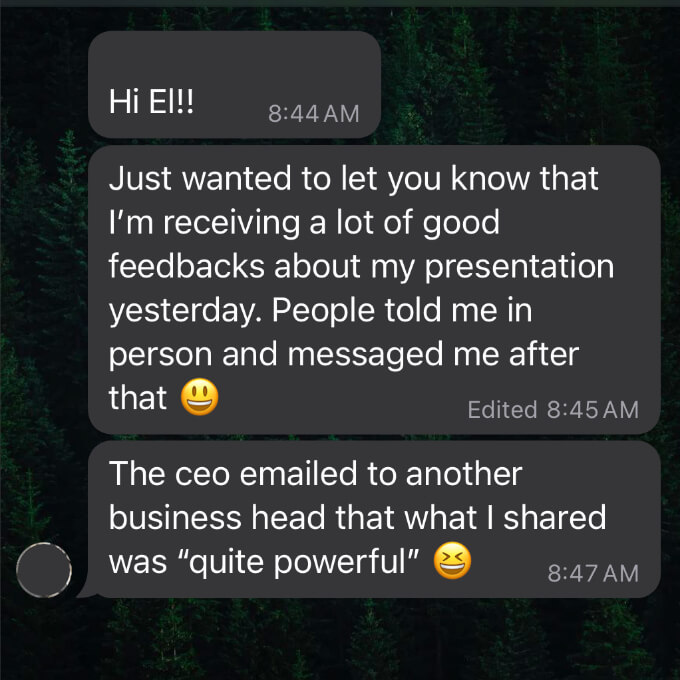
Hi El!! Just wanted to let you know that I’m receiving a lot of good feedbacks about my presentation yesterday. People told me in person and messaged me after that. The CEO emailed to another business head that what I shared was “quite powerful”.
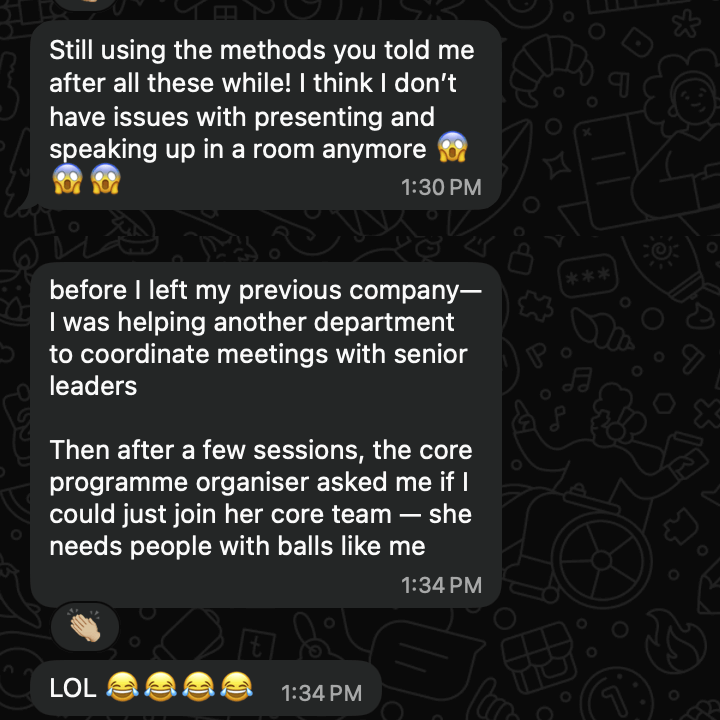
“Still using the methods you told me after all these while! I don’t have issues with presenting and speaking up in a room anymore. I was helping another department coordinate meetings with senior leaders. After a few sessions, the organiser asked if I could join her team — she needs people with balls like me!“
COMPLIMENTARY PRE-CONSULT
What You Can Work On With a Public Speaking Coach in Singapore Using the Embodied Voice Approach
As a public speaking coach in Singapore, I use what I call the Embodied Voice Approach to help to cultivate your confidence for speaking up in front of groups or important people. Basing our work on your present capabilities and real-life situations, you and I can increase your awareness of your body, emotions and mind, so you can harness them with greater freedom. Some of the areas many clients have benefited from:
1. Body Awareness & Nervous System Regulation
Your body is your ‘container’; it is foundational to your possibilities. In the Embodied Voice Approach, we uncover how you can down-regulate yourself in the moment – from grounding, all the way to mustering your energy for your conversational moves. This will help with distressing emotions such as anxiety that might arise from stage fright.
2. Clarifying & Conveying Thoughts With Clarity & Impact
We’ll examine what happens emotionally when you are interrupted, challenged, observed or put on the spot, so you can remain present and structure your response. To aid this, we can equip you with conversational structures that help you to deliver your content logically and clearly. Most importantly, you can learn how to bring these two parts together in a way that resonates emotionally with your listeners as well.
3. Flow in Real Time, Not Memorize Scripts or Formulas
Instead of rehearsing a perfect monologue, we simulate what really goes on for you in your unique situation. Interruptions, objections and intimidating characters are part of the workplace, so we will put you through your paces and practice – through simulations and experiments. The work is to help you build deep awareness of how you show up under pressure, so you can recover and respond – not just recite or try to steer the conversation according to a rigid plan. After all, public speaking is a form of interpersonal communication – you ultimately have to learn how to manage and flow with your fellow communicants.

4. Voice & Body Language
Believe it or not, items like ‘voice projection’ and ‘body language’ are typically the last on the list when you work with me. Not because they’re useless, but rather because they’re usually (and naturally) resolved when we focus on the overall congruence between your physical, emotional and mental aspects – what is referred to as your ontology. For example, one aspect of voice projection is to learn how to speak at a higher volume. However, without a larger context supporting it, it tends to remain an isolated objective which you ‘must remember to do’, making it a conscious and energy-draining act. But when we ‘re comprehensive enough to align your identity, purpose, emotion, message, narrative structure and how you breath, stand and move, you Embodied Voice will likely and naturally include a speaking volume that’s high enough for the entire room.
Summary: True coaching focuses on your unique needs, building confidence that’s equally-accessible regardless of whether you’re in a pitch, discussion, town hall or networking event. It should give you deep awareness and increased range in how you’re able to show up, instead of formulaic moves or ‘magic phrases’. It should support you to build real capacity, and not just to look good and perform technically.

Monika Agrawal
“What stood out was Ellery’s approach — no rigid scripts or mindset clichés. Instead, he helped me shift how I feel in the moment, making confidence & clarity more natural. I wanted to be assertive without being pushy, & he guided me in finding that balance. “
COMPLIMENTARY PRE-CONSULT














WHATSAPP ELLERY NOW
Who Is Suitable for Ellery’s Public Speaking Coaching?
I’m sure you can already surmise whether my public speaking coaching is for you, based on the numerous testimonials above on this page. Drawing from my clients’ actual background and needs, they tend to be individuals who see themselves in one or more of these ways:
1. in an executive position, or trying to progress to such a level
2. can see their public speaking ability is the key to bigger opportunities
3. want to be able to speak clearly and confidently during unscripted moments
4. want to be able to be comfortable and confident on stage or in the spotlight
5. want to be able to handle impromptu questions or challenges in group settings
6. want to be more influential and impactful when speaking to large groups
7. want to cultivate a strong executive presence that can be felt wherever they go

Results You Can Get From Public Speaking Coaching
Here are the key benefits of working on your public speaking with a professional coach in Singapore:
- More easily regulate intense emotions when speaking to large groups
- An executive presence of your own that feels authentic and grounded
- Clearer, more compelling delivery
- Greater freedom to express yourself, without fear of being judged
- Assert your views without overthinking
- Longer and more meaningful interactions
- Project trust and influence through your confidence
Frequently Asked Questions On Working With Ellery – Your Public Speaking Coach in Singapore
1. What Is Ellery’s Embodied Voice Approach for Public Speaking Coaching?
My Embodied Voice Approach is an ontological method of public speaking coaching that helps executives speak with greater clarity, calm and authority by working with one’s entire being. Instead of focusing only on scripts, stage technique or vocal delivery (i.e. externals), my coaching approach focuses inwards – facilitating deep awareness of how your physical body, emotions and moods, language and thoughts come together to support – or sabotage – your communication goals. You’ll learn how to regulate pressure, organise your thoughts, assert your views and respond in real time during meetings, presentations, pitches, Q&A sessions and high-stakes workplace conversations.
2. How is Ellery's coaching different from public speaking training & courses?
One of my clients, a HR executive, once said it succinctly: “Rank and file get sent to training; leaders seek coaching.” This is why top performers (or those who want a breakthrough) often work with a coach instead of attending another generic public speaking course.
Unlike training classes, my coaching is tailored to your specific needs, character patterns and real workplace situations. I use what I nicknamed the Embodied Voice Approach – an ontological coaching method that works with your entire being (body, emotions and language), so you can tap into more possibilities to speak with greater clarity, calm and authority when under pressure.
This work is also conducted in a private environment where you can experiment freely, notice what happens in the moment, and make practical shifts as we coach. The advantage of working with me is that you will most likely discover what truly works for you, on the spot. In mass-trainings and courses, you’re often collecting techniques and “waiting to see if they work” when you finally try to implement them all by yourself in the real-world.
3. Is Ellery’s public speaking coaching suitable for severe stage fright or extreme introverts?
Yes, coaching can help to overcome severe stage fright and extreme introversion – especially if you are willing to participate actively, experiment beyond your comfort zone, and take ownership of your growth. In my coaching, stage fright and introversion are not seen as ‘something wrong’ or a personality flaw. Through the Embodied Voice Approach, we work through the parts of your being (body, emotion or language) that reinforces the unwanted state, so you can learn to intentionally shift away from that way of being.
The most important factor is your ownership. Coaching is not like going to a doctor and passively waiting to be treated. If you come expecting me to “fix” you without your active involvement, coaching may not be the right fit. But if you are willing to practise, observe yourself honestly, and try different ways of approaching your challenges, you are likely to see meaningful improvement.
That said, coaching is not a substitute for therapy or medical treatment, especially if it involves symptoms that severely disrupt daily life.
4. How long does it take to see results through Ellery's coaching?
How many coaching sessions you need is ultimately determined by your existing capacity and resistances (i.e. what you’re currently able and not able to do), and how intensively you’re willing to practice showing up differently in your real-world settings. And of course, the complexity of your challenges and environment are huge factors too.
The variability of factors is exactly why the personalised nature of coaching is useful (as compared to the one-size-fits-all nature of training).
The variability between each person is also why I always do a ‘chemistry’ coaching session with you before we commit to long-term work together. Your possible scope of work will be quite evident after we complete the session.
5. What makes Ellery uniquely-qualified as a public speaking / executive communication coach?
My background is highly unique because I did not come into communication coaching through academics or as a presenter. I first studied and worked as a character animator, where I had to understand acting, visual communication, physical anatomy, emotion and intention deeply enough to make animated characters express their intentions convincingly, and with emotional impact.
Later, as an entrepreneur, I took on trainer and facilitator roles as I spent years engaging classrooms, developing instructors, leading teams, handling difficult conversations, giving feedback, building trust and facilitating sensitive topics. I also designed and facilitated brand storytelling work for enterprises, where communication had to be clear, human and commercially meaningful. This is on top of the expected pitching, presenting, networking and negotiations I had to do on behalf of my business. You can be sure I had a personal stake in honing my communication skills!
Besides a solid grounding in ontological coaching through Newfield’s certification and the ICF’s mark of quality as a PCC, I am Asia’s only coach certified in Embodied Yoga Principles, which allows me to draw from historically-universal principles of embodiment to support you to make visceral shifts in a variety of ways, in order to meet your communication challenges confidently. So to be clear… I’m not a yogi ◡̈
This combination informs my Embodied Voice Approach: helping executives work on how their body, emotion and language come together, so they can communicate with awareness, intention and impact.
COMPLIMENTARY PRE-CONSULT
Bonus: Self-Awareness Exercise to Shift Out of Public Speaking Anxiety
Are you aware of your embodiment in moments of tense emotions? Try this, when you are feeling any emotion that you might describe as negative and intense.
- In which part of your body do you feel this emotion most?
- Let go of your breath, and shift your body into a position that genuinely feels more comfortable, especially doing your best to shift or change the part of your body where the emotion is felt the most. Take a few relaxed breaths and observe – how do you experience the emotion now?
- Reflect; what were you embodying a moment ago, before this exercise? What was it doing for the intense emotion you were feeling?
This is an extremely simple exercise you can experiment with. There are different and more powerful ways of shifting yourself out of distressing states. Changing what you’re embodying is often the quickest and most impactful move you can make.
"To escape criticism: do nothing, say nothing, be nothing."
~ Elbert Hubbard