

[ This article was updated on 06 Jul 2026 ]
Why Emotions Matter in Public Speaking
Public speaking skills are, at their core, emotional skills. Not in a vague, feel-good sense, but in tangible, practical ways. The reason most people freeze, ramble, go off-point or go blank under pressure has less to do with their content preparation, and much more to do with how they are managing — or failing to manage — their emotional state in that moment. As a public speaking coach in Singapore working with executives and professionals, I see this pattern consistently. And once you understand it, the way you approach confidence can change fundamentally.
Client Story: “Stay Logical”
“Sean” was an executive who was newly-appointed over his region. He experienced anxiety and loss of words when he spoke up in executive meetings. He countered this by suppressing his anxiety and “staying logical”. At first, it seemed to help. However, he quickly noticed that it felt more and more difficult to have his listeners stay engaged, and for him to make impact. Eventually, the bored expressions and disengaged actions he saw in his audience (especially his boss) made him resort to speaking fast and saying less. This meant skipping over points that further dampened the impact of what he wanted to express. In the end, this resulted in stronger anxiety and even a new dread towards public speaking.

“Sean” was a client of mine; thankfully, he is much more confident in his communication now. His story was similar to that of many other professionals I’ve helped.
This Public Speaking Coach Says: Harness Emotions
As a public speaking coach in Singapore, I’ve seen again and again how one’s performance for public speaking tends to suffer when they disconnect from emotions.
That’s why I often tell my clients: public speaking skills are, in many ways, emotional skills. In this article, I will attempt to share and explain what’s behind this observation of mine.

In general, my approach as an executive communication and public speaking coach is to help you access and harness emotions — first within yourself, and then in your audience. Below, I’ll share three powerful ways that your public speaking skills are rooted in emotional intelligence, and how you can start tapping on your emotional energy to speak with more confidence, clarity, and connection.
⚠️
Do You Struggle With These Public Speaking Challenges?
Mind going blank (or ‘brain fog’)
Structuring your words
Asserting your view
Speaking up at all
Overthinking
Anxiety

COMPLIMENTARY PRE-CONSULT
3 Ways Public Speaking Skills Are Actually Emotional Skills

① Being Comfortable With Emotion Is a Core Public Speaking Skill
One of the most significant barriers to effective public speaking is low emotional awareness. When you’re disconnected from your emotions, you can appear robotic or detached, which distances your audience and weakens your message.
Imagine delivering a presentation so focused on the script that you ignore the emotional cues from your listeners, so you miss an opportunity to make an impact. Or, you mistake your audience’s curiosity for objection and speed through your slides in order to end your segment as quickly as possible. Being uncomfortable with emotion can lead to your audience feeling disconnected and maybe even feeling you’re off-track, even though you’ve stuck to your script perfectly.

The real skill is learning to be comfortable with emotion — both your own and your audience’s. When you can sit with feelings like nervousness, curiosity, and even anger, you can start to connect more authentically with your audience.
Think of it like building tolerance for spicy food; uncomfortable at first, but rewarding with practice, as the range of foods you will be able to enjoy increases. Similarly, your emotional capacity determines the range within which you can adjust your tone, message, and body language, making your public speaking skills more engaging and human.
I’ll offer a tip on how to cultivate more emotional capacity, further in.

I was hosting a company event & wanted to be a more effective & confident communicator. Ellery shared somatic interventions that helped me manage my emotions. This enabled me to build awareness of my triggers, & how I can access confidence.
I reached out to Ellery previously as I was hosting a company event and wanted to be a more effective and confident communicator.
El was a great listener and very perceptive, noticing what possibly contributed to my discomfort.
Then he shared somatic interventions that helped me manage my emotions. I practiced them with him, so that it was easier to apply in the actual moments of public-speaking. This enabled me to build awareness of my triggers, and how I can access confidence whenever I needed it.
Thanks El for being on point for your guidance and look forward to more interactions to further enhance my communication
COMPLIMENTARY PRE-CONSULT
② More Thinking Will Not Increase Confidence in Public Speaking
Overthinking and self-doubt are two of the most common challenges my clients face before they worked on themselves with a public speaking coach.
During important conversations, is your mind flooded with thoughts such as, “Should I say this?” or “What if I’m wrong?”, until you decide not to speak up at all? Or are you furiously weighing the logical quality of what you want to say, while the moment to speak passes you by?
Many of these same clients also received feedback from their bosses along the lines of, “You need to speak up more,” or “You need to show up more confidently in meetings.” If this is you, it can feel even more nerve-wrecking if your promotion hanging is on this. Or, you might be newly-promoted and suddenly realize that you need to speak up with assertively and without hesitation
You might already have noticed – the root of that hesitation isn’t a lack of ideas. It’s clearly something else. If so, I suggest that it’s emotional in nature.

Sometimes it shows up as imposter syndrome, where you doubt your abilities or even self-worth. This emotional loop weakens your presence and causes your message to sound uncertain. You might even try to shrink away entirely.
The solution isn’t to “think” your way out of overthinking. Yes, our logic needs to be sound, but ultimately, the way forward is through action — and action is fuelled by emotion.
Notice again: isn’t your overthinking the ‘logical’ side yourself? Despite having strong logic, you weren’t able to act. There is something stronger at work within your self.
That’s why, in communication coaching, we work to harness emotion – the “spark” that propels you speak up with conviction and confidence.
③ Expecting Anxiety Is Key To Better Public Speaking Skills
Anxiety is one of the most feared emotions in public speaking, and it can become more destructive when you fight it. When intense, it can cause shaking, sweating, or that dreaded blank mind moment. Your audience may notice confusion, hesitation, or loss of flow, all because you were fighting to hide your anxiety. Ironically, nothing screams “I’m anxious!” more than trying to fight anxiety, don’t you agree?
That’s why I coach my clients to expect anxiety instead of fearing it. When you accept it as a natural response, you stop wasting energy trying to suppress it. Through assistance such as coaching, you can learn to work with it, so you stay alert and present. And of course, there’s the critical requirement of cultivating greater emotional capacity, so you can work with your anxiety with more agility and for longer durations. These changes can then open your way to stronger connection and impact when you speak.

I make my public speaking coaching sessions practical for both the public stage and the private table by helping you learn how to stay grounded, maintain presence… and act with intention. This allows you to be effective in spite of anxiety. It builds authenticity and trust — qualities that make your public speaking more powerful and persuasive.
COMPLIMENTARY PRE-CONSULT
Coach Ellery’s Tip: A Practice for Emotional Capacity
Here’s a simple process you can practice to start increasing your emotional capacity.
- Notice moments when you feel (any of) your emotions strongly.
- Instead of brushing it away or distracting yourself with a different matter, allow yourself to sit with that emotion.
- Simply feel the emotion as fully as possible, without going into solutions, ‘why’s, or judgements.
- When it feels like you’ve held this for as long as you can, let it go.
- Practice the same thing again the next time it happens. Be gentle with yourself as you slowly increase the amount of time you can stay with strong emotions.
A Client’s Ad Hoc Testimonials of Success in Presentations & Public Speaking
“People with balls” would be the last thing you’d think of this client of mine, if you encountered her in the past. She sought me out because she was riddled with anxiety at the workplace. Even an unexpected “Hello, how are you” from a colleague would make her anxious. She suffered low confidence in her official duties whenever she had to facilitate meetings between different departments, or to formally present her views. The tension from the discussions and questioning often made her freeze.
Today, after coaching with me and actively practicing what she’s learnt, she has no issues with presenting and speaking up in the room. This embodied, felt sense of confidence was validated in the form of feedback from her CEO, as well as invitations to work with senior leader teams.
Her own words are captured in the screenshots below. Her full testimonial can also be found here.
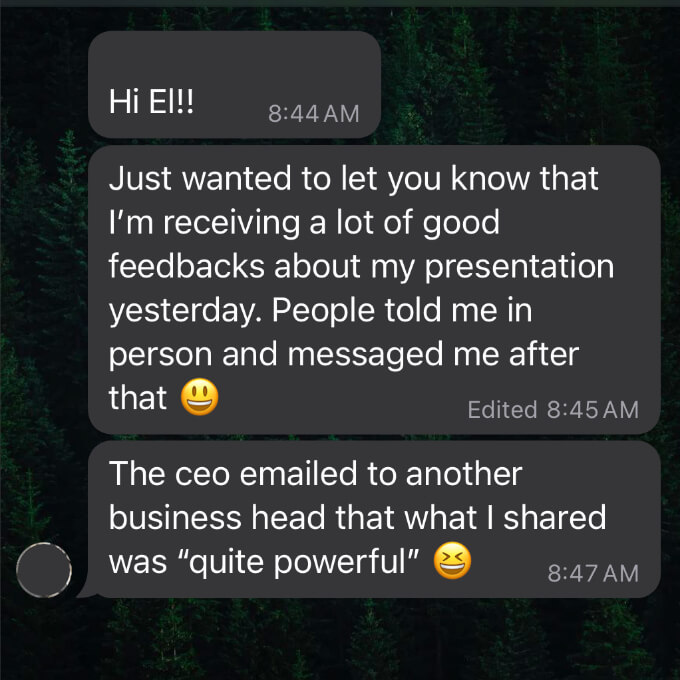
Hi El!! Just wanted to let you know that I’m receiving a lot of good feedbacks about my presentation yesterday. People told me in person and messaged me after that. The CEO emailed to another business head that what I shared was “quite powerful”.
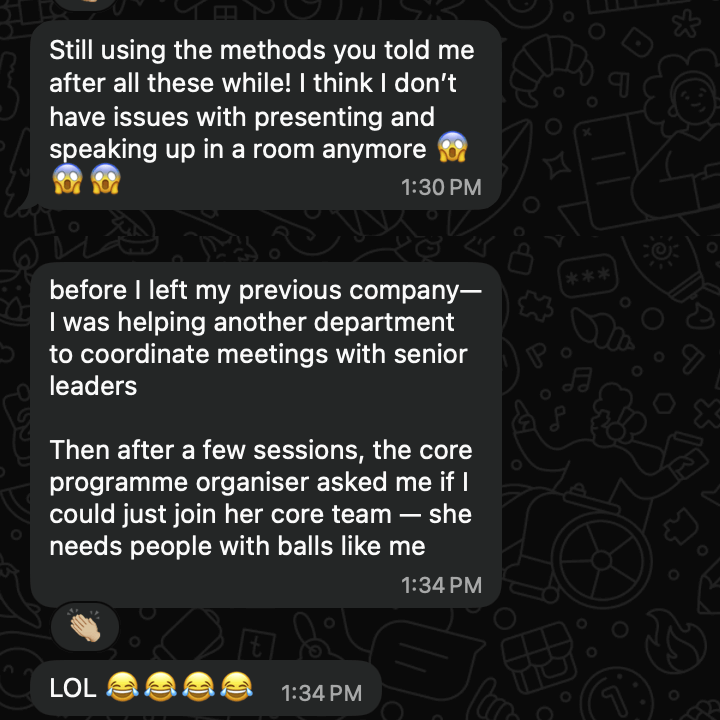
“Still using the methods you told me after all these while! I don’t have issues with presenting and speaking up in a room anymore. I was helping another department coordinate meetings with senior leaders. After a few sessions, the organiser asked if I could join her team — she needs people with balls like me!“
COMPLIMENTARY PRE-CONSULT
Effective Communicators Are Emotionally Skilled
By now, you can see how the belief that “professionals should keep emotions out” is a myth that can undermine the potential of speakers and executives. Emotions are not distractions, they are data; they are fuel. They reveal what matters, help you read your audience, and are key to influence and power.
Learning to understand, manage, and express emotions is one of the fastest ways to improve your public speaking skills. It can help you speak up in meetings, present ideas clearly, and connect meaningfully with your audience. This can make a significant difference if you are in the running for a promotion, or need to establish your leadership presence.
If you are ready to strengthen both your emotional intelligence and communication confidence, 1-on-1 coaching can be an effective next step.
How a Public Speaking Coach in Singapore Can Help You
As a full-time public speaking coach in Singapore, I’ve helped numerous clients from various industries overcome anxiety, overthinking, and fear of judgment. Every coaching engagement is shaped around your specific patterns, context, and goals — and grounded in what I call the Embodied Voice Approach, an ontological method that works with your body, emotions and language as a whole. But there are five things that happen every time:
1. Discovery & Reflection
We surface not just what you say, but how you say it: where your voice tightens, where your body braces, where your thinking goes flat under pressure. Most clients discover that their communication challenges have a physical signature they’ve never noticed before.
2. Awareness & Reframing
You learn to catch the moment before the freeze, the over-explanation, or the ramble begins. This isn’t about positive thinking — it’s about recognising the early signals your body sends and choosing a different response before the pattern takes over.
3. Equipping
We build a personal toolkit that works with your nervous system, not against it. This includes somatic techniques for staying grounded under pressure, structural tools for coherence under time constraints, and practices for recovering composure mid-conversation when things go sideways.
4. Authentic Practice
We simulate your actual situations: the meeting where you go blank, the stakeholder who challenges you, the group discussion where you disappear. Real conditions, not abstract exercises — because the body needs to rehearse the experience, not just the words.
5. Calibration & Growth
You take these skills into your real interactions and bring back what you notice. We use that feedback to sharpen and adjust — because the goal isn’t a performance you can repeat in ideal conditions. It’s a shift in how you show up when conditions aren’t ideal.

My confidence has markedly improved. I overcame my anxiety, focusing on communicating my message authentically.
Sought Ellery out at one of the lowest points in my life. At the time, I had gotten out of a toxic work environment and was fortunate to land a new role elsewhere. However, my confidence and mental state were at rock-bottom, which I felt impeded my ability to function effectively at work and in my personal life. I would describe my situation then as moving in a fog. For example, my lack of confidence resulted in anxiety before giving presentations, weighed down by my expectations of how a “perfect” presentation should be and fears of how I would be perceived by my audience.
Ellery knew how to ask the right questions and guide the conversation toward my blind spots which allowed for introspection – I was able to pinpoint certain triggers and gain clarity on why I feel or respond to situations in a certain manner. During the session, Ellery was very present and attuned. He was also able to effectively parse through what I said and accurately identify the key issue.
The somatic exercises Ellery taught have immensely helped me in stress and emotional management, as well as release past trauma from work and personal situations. I have realized the importance of “emptying my vessel” regularly so I have capacity to take on other things. I have also learnt how to better set boundaries and communicate my expectations more effectively. I have also become less concerned about how I am perceived by others. My confidence has markedly improved as a result and I am more willing to step out of my comfort zone. In terms of presentations, I was able to overcome the anxiety and focus on communicating my message authentically, focusing on what I want to deliver instead of how I deliver.
For anyone working on their self-care / healing journey, or are looking to develop their confidence and communication skills, I would highly recommend Ellery. Seeking him out is one of the best decisions in my life and I am happy to share that I am not as lost as I once was.
COMPLIMENTARY PRE-CONSULT
Shared Roots: Public Speaking, Interpersonal Skills & Executive Communication

The emotional patterns that surface in public speaking don’t disappear when there’s no stage and no audience. They show up when you’re put on the spot in a leadership meeting, when you over-explain yourself to a senior stakeholder, when a tense one-on-one conversation makes your thinking go flat. These are interpersonal and executive communication challenges — but their roots are the same. When the emotional stakes feel high, the same loss of groundedness, clarity, and coherence kicks in.
This is why clients who come for public speaking coaching with me frequently report that their most significant shifts happen not on a stage, but in the everyday professional interactions that actually determine how they are perceived: the hallway conversation, the difficult feedback, the moment someone challenges them and they need to hold their ground without losing their composure.
COMPLIMENTARY PRE-CONSULT
What is Coaching?
Coaching is a form of super-customised learning, focused solely on your needs. It is one of the most dignified forms of professional help, because you choose the topic, direction and depth of what you wish to work on.
In fact, my clients are NOT ‘broken’ in any way. They are capable, creative and self-initiated individuals who want to live out their full potential. Many of them are high-performers at their workplace.
They just want support to help them hit their objectives more quickly and with less pain.
If taking ownership of your growth appeals to you, coaching is might be suitable for you.
WhatsApp me now to find out how you and I can work together on your communication and confidence.













COMPLIMENTARY PRE-CONSULT
Frequently Asked Questions on Ellery’s Public Speaking Coaching
1. How can Ellery help me as a public speaking coach?
As a public speaking coach, I can help you improve your communication skills through personalised learning that has exploration and experimentation at its core. The aim is to help you increase your self-awareness, capacity and skills by uncovering your unique blindspots and develop methods to get you unstuck from your challenges.
2. What sets Ellery's public speaking coaching apart from the others out there?
El’s public speaking coaching addresses spontaneous, high-stakes interactions: the moment you’re put on the spot in a meeting, steering the group discussion back on track, and the impact you want to land for your audience. These ad hoc moments are harder to prepare for than a rehearsed speech because they require more emotional readiness than script-readiness. Rather than drilling slides and ‘stage acts’, Ellery’s coaching builds the underlying emotional capacity — the ability to stay grounded under pressure, think clearly when anxious, and speak with coherence when it counts. Because for most professionals, it is the day-to-day conversations that shape their credibility.
3. How is public speaking coaching different from public speaking training?
One of clients who is a HR executive once said it succinctly, “Rank and file get sent to training; leaders seek coaching”. This is why top performers, or those who want a breakthrough, work with a coach.
Training classes tend to follow linear, rigid lesson plans that are one-size-fits-all. Unlike training classes, my coaching is tailored to your specific needs and character patterns. It is also conducted in a private environment where you can experiment freely, leading to faster, more authentic growth. Specificially, my coaching unfolds over time, following your real-life progress and evolving needs.
The advantage of working with me is how you will can often experience positive shifts right there in the coaching room, instead of having to wait to “see if it works”. This because of my background as an ontological coach.

COMPLIMENTARY PRE-CONSULT
4. Is Ellery's public speaking coaching only for executives?
No, although mileage obviously varies with your actual job requirements. My public speaking coaching benefits anyone who wants to express themselves more clearly and confidently. After all, the ability to communicate and influence is crucial both for professional as well as social success. If the essence of public speaking is to express oneself fully, clearly and confidently, then this work can impact your life positively, regardless of whether you are addressing your team or your spouse. My work often includes supporting clients to manage conflicts and improve relationships, through better communication.
5. Is Ellery's public speaking coaching relevant if I'm challenged in 1-on-1 & meeting room-sized interactions?
Yes — and the overlap is more direct than most people expect. The same emotional patterns that cause someone to freeze during a presentation also drive the hesitation before speaking up to a senior stakeholder, the over-explanation in a tense one-on-one, or the loss of composure when challenged in a meeting. Ellery’s coaching addresses these as a unified problem: the inability to stay grounded, clear, and coherent when the emotional stakes feel high. Whether the context is a formal presentation, a difficult interpersonal conversation, or an executive discussion where credibility is on the line, the underlying work is identical — building emotional capacity so that your communication holds up under pressure, not only when you’re allowed to rehearse. This is why clients who come for public speaking coaching frequently report the most significant shifts in their day-to-day interpersonal and group interactions.
6. How many coaching sessions will I need with Ellery?
How many coaching sessions you need is ultimately determined by your resistances (i.e. what you’re currently find easy or difficult to do), and how intensely you’re willing to practice showing up differently in your real-world settings. And of course, the complexity of your challenges and environment are huge factors too.
The variability of factors is exactly why the personalised nature of coaching is useful (as compared to the one-size-fits-all nature of training).
The variability between each person is also why I always do a ‘chemistry’ coaching session with you before we commit to long-term work together. Your possible scope of work will be quite evident after we complete the session.
If you already know what you want, and would like to move things along more quickly, you can book a ‘chemistry’ coaching session with me through the button below ⬇︎
"Life shrinks or expands in proportion to one's courage."
~ Anaïs Nin