

A Client Story: Wanting Coaching for Public Speaking in Singapore
I recently onboarded a new client; she wanted a public speaking coach in Singapore. She wanted to work on herself because she suffered from anxiety when speaking at important discussions and presentations. She would hold back from expressing her ideas, looking for ‘the right moment’ to speak up, because she wanted to create maximum impact with her words. Ironically, this often ended up with her keeping silent throughout the entire discussion.
All this happened despite the fact that she was already a director, and she was a competent subject matter expert. Her confidence in her own communication was already plummeting when, one day, her boss said she needed to speak up more. That finally got her to seek coaching for public speaking.
Why Leaders Often Need Coaching the Most
The cost of staying quiet becomes higher as you move up in leadership. Decisions are made in the room — and influence belongs to those who can speak in the moment, not just afterwards.
This client recognised something important: promotion does not automatically rewire how you show up under pressure. Coaching will give her a dedicated space to recalibrate how she holds authority, expresses disagreement, and enter conversations with composure. Seeking coaching wasn’t a sign of weakness — it was an act of leadership maturity.
Pain Points I’ve Seen as a Public Speaking Coach
① Capable on paper but invisible in the room
Can you imagine that? You’ve spent enough years in your field. You produce good work, and you know your stuff. But because you cannot communicate as confidently as you’d like, people don’t believe how capable you really are.
As a public speaking coach in Singapore, I know how commonly this shows up in meetings (especially the ones with executive involvement), when discussions or updates occur, impromptu. Questions are traded at a fast pace and you have trouble focusing your thoughts and structuring your replies. Queries and doubts about your work are levelled at you, and you need to assert yourself in front your peers and your boss.

But you lack the confidence to speak up, so you keep quiet, and the moment passes. You feel your credibility shrink a little more, as the ‘win’ goes to someone else at the table.
Someone who’s more visible and assertive. Someone who seems much more comfortable with public speaking.
☝🏼Sound familiar?

Ahmed Basir Amir Sultan
President, IMPROF Exec. Committee | MUIS Council Member
In one session, he led me through somatic movements that shifted something in me. I could feel the internal shifts within minutes. By the end of that session, the thing that used to trigger my anxiety had lost its grip. It also exposed the false voice that kept telling me I wasn’t good enough.
The work with Ellery is practical and physical, not just conceptual. In one session, he led me through somatic movements that shifted something in me. It was a kind of settling into myself, as if I was there to serve rather than to prove. It was practical because I could feel the internal shifts within minutes. By the end of that session, I couldn’t feel the microphone anymore; the thing that used to trigger my anxiety had lost its grip. It also exposed the false voice that kept telling me I wasn’t good enough.
He also gave me public speaking tools I still practise. I use breath work at the start of each speaking session to regulate myself and the audience. I also have words I can bring into a conversation to ground myself when I’m facing tough or unexpected questions. These aren’t scripts. They help me access ways of being that are useful for leading and influencing.
I’m still working with Ellery on my executive communication and presence, as there’s more ground I want to cover, but the shifts from just a few sessions have already had a big impact. For anyone in leadership, community work, or any space where your voice carries weight, I’d point you to Ellery at www.elleryng.com.

FOR A COMPLIMENTARY PRE-CONSULT
② The more you prepare, the more anxious you feel
Or, your challenges with public speaking might involve the classic challenge of corporate communications: presentations. You’re an expert in your field, but if you’re tasked to do a talk, or to present your work to an audience, you feel like you’ve been sentenced to face a firing squad.
Public speaking terrifies you. And if you’re like the clients who first sought me as a speaking coach in Singapore, your dread grows in the lead-up to the day of the presentation. The anxiety only seems to increase as you memorise your deck and rehearse your script.
And then, you’re become a nervous bundle during the opening of the presentation. If you somehow made it through without interruptions, you get hit with the Q&A, where your fear shoots through the roof and your confidence plummets further.

You can’t tell if it’s your brain or your mouth that’s blocking you from speaking. All you can think of is how you don’t want to appear ignorant in front of your colleagues and bosses. You feel all eyes are on you and they’re judging you.
It’s one of the most awful feelings in the world, and you can’t wait to dash out of the spotlight.
☝🏼Do you resonate with this?

Ellery shared somatic interventions that helped me manage my emotions. I practiced them with him, so that it was easier to apply in the actual moments of public speaking. This enabled me to build awareness of my triggers, and how I can access confidence whenever I needed it.
I reached out to Ellery previously as I was hosting a company event and wanted to be a more effective and confident communicator.
El was a great listener and very perceptive, noticing what possibly contributed to my discomfort. Then he shared somatic interventions that helped me manage my emotions. I practiced them with him, so that it was easier to apply in the actual moments of public speaking. This enabled me to build awareness of my triggers, and how I can access confidence whenever I needed it.
Thanks El for being on point for your guidance and look forward to more interactions to further enhance my communication skills!
③ Many words but no impact
Or perhaps your struggle isn’t only about meetings or presentations; it’s about bringing impact and being taken seriously.
You do speak up. You do contribute. Yet your points don’t land with the weight you intend. You explain yourself, then find yourself explaining again. Others interrupt, talk over you, or later rephrase your idea — and that version suddenly gets acknowledged!
As someone focused on communication confidence in Singapore, I see how this slowly wears people down.

You start second-guessing your words before you even open your mouth. You soften your statements. You add disclaimers. You over-explain, hoping clarity will earn credibility — but instead, your message gets diluted and your presence weakens.
It’s deeply frustrating because you’re not lacking intelligence or intent. Yet you walk away from conversations wondering why you weren’t heard the way you meant to be, or why asserting yourself feels risky… or even wrong.
☝🏼 Is this part of your experience?
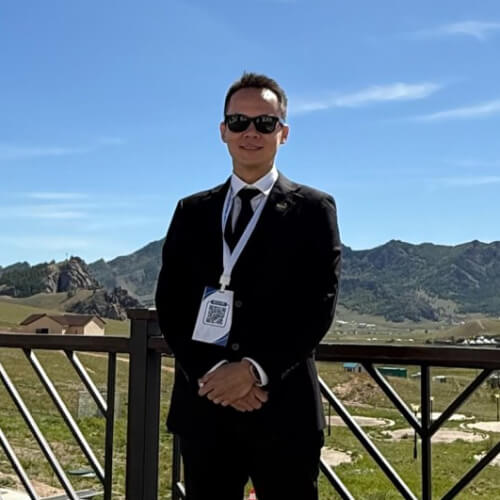
When the day came, my speech went much better than I expected, and I actually enjoyed delivering it, which hadn’t been the case before! It’s not an overstatement to say this was a breakthrough moment that shifted how I approach public speaking from then on.
I’ve spent a lot of time speaking in front of large groups — as a pilot, an instructor, and as union president — so it wasn’t that I couldn’t speak in public. Yet, there was something deeper going on: I’d lose sleep before a big speech. During the moments I’m speaking up in front of large groups (especially with unfamiliar or ‘powerful’ figures), my voice and my hands could shake… and once, I nearly fainted during a high-pressure meeting. I could get through it, but I couldn’t actually be present or enjoy it.
This was why I went looking for a public speaking coach in Singapore. Specifically, one who could help me understand myself at a deeper level and actually change how I feel, instead of giving the usual stage-performance advice I’d already heard before.
What stood out working with Ellery was how quickly we got to the actual cause. Instead of just working on delivery, we worked on what was happening in my body — using breathing and tension-release techniques to deal with the anxiety at the source, rather than just trying to manage it or hide it. That shift alone changed how I prepared for any high-stakes speaking engagement.
One of the things I appreciate about El’s coaching was how it focused on embodiment, instead of only mental effort or conceptual models. While they can be simple to learn, the impact goes deep (so long as you put in the practice). Most importantly, they are highly practical and applicable.
Thanks to Ellery’s own experience in public speaking, he was also able to help me with a game plan for one of my upcoming high-profile speeches. We came up with a list of strategic things I could do before and during the event that could swing the outcome even more strongly in my favor. And of course, more somatic techniques I could use to regulate myself and bring on the kind of engaging presence I wanted on stage.
When the day came, my speech went much better than I expected — and I actually enjoyed delivering it, which hadn’t been the case before! It’s not an overstatement to say this was a breakthrough moment that shifted how I approach public speaking from then on.
If you see yourself as a speaker, but are still overcome with anxiety, or if speaking up in front of large groups is something you need to do often, look for El at elleryng.com. His public speaking coaching helped me refine my authentic, executive presence and to speak confidently in front of crowds.
FOR A FREE PRE-CONSULT
Why Public Speaking Training & Self-Practice Often Fall Short — & What Coaching Does Differently
Many capable professionals invest time and effort into improving their public speaking. They attend workshops, watch videos, rehearse scripts, and practise on their own. While these approaches can sharpen techniques, they often fail to create lasting confidence — especially in high-stakes, unscripted moments.
This is not due to a lack of discipline or intelligence. It’s because confident communication is not built by information alone.

Why effort & practice alone don’t change confidence
Most public-speaking training focus heavily on what to say and how to structure ideas. What it rarely addresses is how you experience yourself in the moment.
When pressure rises — during executive meetings, Q&A sessions, or important presentations — the nervous system takes over. Overthinking, a blank mind, a racing heart, or a shrinking presence are not logical problems; they are embodied responses. Practising alone often reinforces these patterns, because you are rehearsing from the same internal state that already limits you.
This is why many professionals find themselves stuck: knowledgeable, prepared, yet still hesitant or anxious when it matters most.
What coaching changes that self-training can’t
Instead of memorising scripts or relying on mental tricks, coaching helps you develop the capacity to stay grounded, clear, and responsive as situations unfold. You learn how to regulate yourself under pressure, organise your thoughts while speaking, and remain present even when challenged or interrupted.
This is what makes confidence portable: it shows up not just in rehearsed presentations, but in meetings, discussions, negotiations, and spontaneous conversations.

How Ellery Ng’s coaching approach is different
Sessions are built around your real workplace contexts, cultural dynamics, and actual challenges — not generic formulas. We work with live scenarios, internal reactions, and moment-to-moment adjustments, so that clarity and authority become felt, not forced.
The result is not a polished performance, but a more confident, steady version of you — able to speak up, engage others, and be taken seriously across varying situations.
This difference is not theoretical — it shows up in how confidence is built and sustained over time.
FOR A FREE PRE-CONSULT
How a Public Speaking Coach in Singapore Helps You Build Lasting Confidence
Building lasting confidence requires more than understanding why tips and self-practice fall short — it involves working with how you think, feel, and respond in real situations. Provided you have done your due-diligence in preparing, the reason(s) why you might suffer low confidence in public speaking is usually a combination of mental and emotional. In fact, I often suggest that public speaking (or impactful communication, for that matter) is actually emotional at the core.
For example, notice how, if you want to land an impact with your communication, you’re actually wanting to create an emotional response in your audience. Notice as well, how you might be able to parrot your presentation script, but your nerves can still derail you and wipe your mind blank on stage. Ditto for when your views are challenged in a discussion — notice how it’s your emotions holding you back, even when you know you’re right.
At its core, confident, effective public speaking is actually less about logic and more about emotion!

I've become less concerned about how I am perceived by others. My confidence has markedly improved. In presentations, I overcame my anxiety, focusing on communicating my message authentically.
Sought Ellery out at one of the lowest points in my life. At the time, I had gotten out of a toxic work environment and was fortunate to land a new role elsewhere. However, my confidence and mental state were at rock-bottom, which I felt impeded my ability to function effectively at work and in my personal life. I would describe my situation then as moving in a fog. For example, my lack of confidence resulted in anxiety before giving presentations, weighed down by my expectations of how a “perfect” presentation should be and fears of how I would be perceived by my audience.
Ellery knew how to ask the right questions and guide the conversation toward my blind spots which allowed for introspection – I was able to pinpoint certain triggers and gain clarity on why I feel or respond to situations in a certain manner. During the session, Ellery was very present and attuned. He was also able to effectively parse through what I said and accurately identify the key issue.
The somatic exercises Ellery taught have immensely helped me in stress and emotional management, as well as release past trauma from work and personal situations. I have realized the importance of “emptying my vessel” regularly so I have capacity to take on other things. I have also learnt how to better set boundaries and communicate my expectations more effectively. I have also become less concerned about how I am perceived by others. My confidence has markedly improved as a result and I am more willing to step out of my comfort zone. In terms of presentations, I was able to overcome the anxiety and focus on communicating my message authentically, focusing on what I want to deliver instead of how I deliver.
For anyone working on their self-care / healing journey, or are looking to develop their confidence and communication skills, I would highly recommend Ellery. Seeking him out is one of the best decisions in my life and I am happy to share that I am not as lost as I once was.
This is why, when I coach you on public speaking in Singapore, I pay attention to how emotions are evoked (or provoked) in you, when you are in public-speaking situations. I help you to uncover such blindspots so that you can stop allowing yourself to be disempowered. When your self-awareness in this area grows, you’ll be able to show up more confidently AND authentically, be it to present information, helm Q&A, or to stand up to a verbal challenge.
I believe strongly in the importance — and the possibility — that you can make progress even as you’re being coached. As such, I emphasize on techniques and practices that will allow you to make positive shifts almost immediately, as long as you’re committed to change, and open to new ways of seeing.
FOR A FREE PRE-CONSULT
What Coaching Is
Coaching is a form of super-customised learning, focused solely on your needs. It is one of the most dignified forms of professional development, because you choose the topic, direction and depth of what you wish to work on.
Through personal coaching, you can improve your public speaking and reclaim your confidence at work. This is familiar territory I’ve visited with clients on over the years, as a full-time life coach, specializing in communication and confidence.

Customized to Your Public Speaking Development Needs
Every coaching engagement is unique, because each client has different needs, weaknesses and strengths. However, there are processes that unfold every single time:
- Through open exploration and in-depth reflection, we will uncover your blindspots.
- Once you can see the cause or nature of your issue, you might also be able to see how you can do things differently so you get different result.
- I can also guide you to try new ways of saying or doing things, that are effective and feel authentic for you.
- Together, we will co-create practices that you can adopt, to assimilate what you learn into your regular way of being.
- I will provide you with honest feedback which you can use to calibrate and fine-tune your new skills.
If improving more quickly and with unnecessary less pain sounds good to you, WhatsApp me now to start your change!
A Client’s Reports of Success in Presentations & Public Speaking
“People with balls” would be the last thing you’d think of this client of mine, if you encountered her in the past. She sought me out because she was riddled with anxiety at the workplace. Even an unexpected “Hello, how are you” from a colleague would make her anxious. She suffered low confidence in her official duties whenever she had to facilitate meetings between different departments, or to formally present her views. The tension from the discussions and questioning often made her freeze.
Today, after coaching with me and actively practicing what she’s learnt, she has no issues with presenting and speaking up in the room. This embodied, felt sense of confidence was validated in the form of feedback from her CEO, as well as invitations to work with senior leader teams.
Her own words are captured in the screenshots below. Her full testimonial can also be found here.
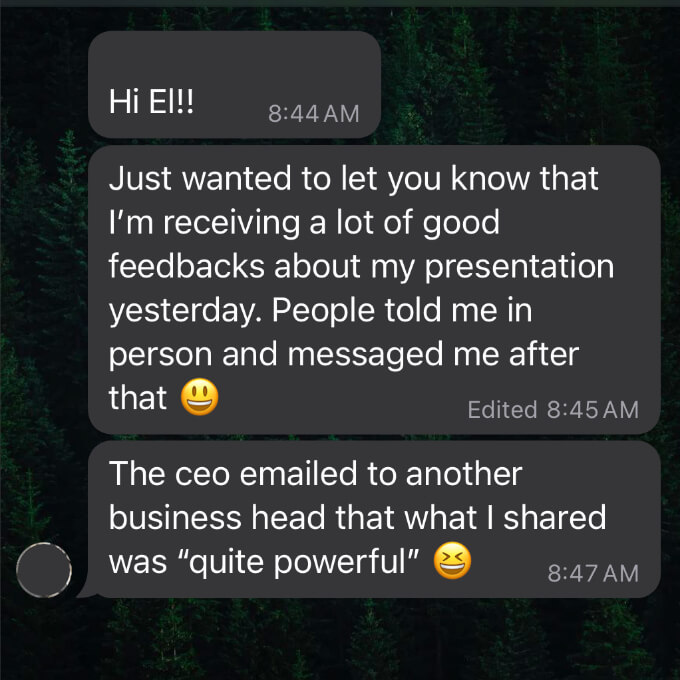
Hi El!! Just wanted to let you know that I’m receiving a lot of good feedbacks about my presentation yesterday. People told me in person and messaged me after that. The CEO emailed to another business head that what I shared was “quite powerful”.
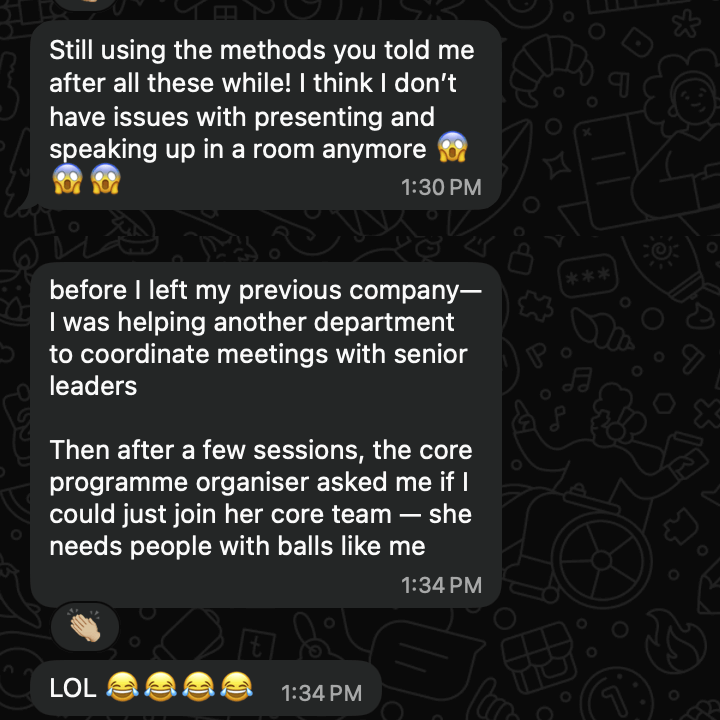
“Still using the methods you told me after all these while! I don’t have issues with presenting and speaking up in a room anymore. I was helping another department coordinate meetings with senior leaders. After a few sessions, the organiser asked if I could join her team — she needs people with balls like me!“
FOR A FREE PRE-CONSULT
Frequently Asked Questions: Coaching for Confidence
1. Is hiring a public speaking coach in Singapore worth it?
Yes — if public speaking anxiety has been holding you back from career growth or visibility, a coach can help you make measurable progress faster. Videos and books give tips, but a coach provides live feedback, realistic practice, and accountability to make confidence stick.
2. How long does it take to see results with public speaking coaching?
It varies by person, but many clients report noticeable improvements in confidence and delivery after just a few sessions. Sustainable change — especially for high-stakes environments like board meetings or presentations — typically takes consistent practice over several weeks or months.
3. What’s the difference between a public speaking coach and general communication training?
A public speaking coach works closely with your specific challenges — such as anxiety, presence, or clarity of speech — and helps you develop personalized strategies. General training tends to be broader and less tailored. Coaching ensures the focus stays on your goals, in your real work context.
4. How is ontological coaching different?
Ontological coaching works with your entire being — your mind, emotions and body. Because of this, the coaching process and your learning tends to be more experienced rather than (merely) logically understood. You can perceive positive shifts on-the-spot, rather than having to wait and “see if it works” in your real-life situations. The quality of your presence also tends to shift, due to the attention that we pay to the emotional aspects of your communication.
"To escape criticism: do nothing, say nothing, be nothing."
~ Elbert Hubbard