

Observations From a Coach Specializing in Executive Coaching in Singapore
In my work of executive coaching in Singapore, I frequently encounter individuals who find themselves in the unfamiliar shoes of leadership. The scenario typically goes like this…
You’ve worked hard to build your technical expertise, and it’s brought you to this new role—a promotion into leadership. But while your technical skills got you here, being effective in a leadership role calls for a different set of abilities. Your work is no longer about just the tasks or projects you manage; it’s about understanding and motivating people, leading through complex situations, and communicating with clarity and confidence.

This shift can feel daunting. In a fast-paced environment like Singapore, new executives and managers face high expectations. The transition from a hands-on technical role to a leadership role requires a keen understanding of how to work with people—often without the experience or guidance to navigate these changes.
It’s extremely difficult to learn these skills in a course, because most of them are caught, rather than taught. It requires practice, out there in the real-world. Hence, many organizations and individuals employ executive coaching in Singapore as a resource to cultivate confidence, improve communication, and lead with intention.
In my years of executive coaching in Singapore, I observe that leaders are frequently beset by the following 6 pain points.
6 Pain Points: Why Leaders Seek Executive Coaching in Singapore

① You want to be more assertive, but fear offending others.
② You feel you should speak up, but you keep quiet instead.
③ You overthink or people-please.
④ You struggle with your words and sentences, as well as your decisions.
⑤ You feel awkward in conversations and disengage too quickly.
⑥ You want your presence to be stronger in group interactions.
Executive coaching can help you to overcome these pain points, in a way that is super-customized and relevant for your leadership challenges.

FOR A FREE PRE-CONSULT
① Building Assertiveness Without Offence

Being assertive is an essential ability for leaders, but many fear offending or hurting their team members. A skilled executive coach can help you find the balance, enabling you to stand your ground, make your ideas heard, and command respect without damaging relationships.

I wanted to be assertive without being pushy, & El guided me in finding that balance. I now engage more confidently, even with senior leaders. I've continued to grow in confidence & communication & was recently promoted!
Working with Ellery was a game-changer during a challenging phase in my career. Despite years of hard work and public recognition, I struggled to assert myself in difficult conversations, which impacted my confidence and career progression.
Through practical strategies, Ellery helped me identify blind spots in my communication—especially in managing tone and presence to be taken more seriously. I wanted to be assertive without being pushy, and he guided me in finding that balance. What stood out was his approach—no rigid scripts or mindset clichés. Instead, he helped me shift how I feel in the moment, making confidence and clarity more natural. His feedback was always constructive, creating a safe space for real growth.
Thanks to his coaching, I now engage more confidently, even with senior leaders, and advocate for what I deserve. Since working with Ellery, I’ve continued to grow in confidence and communication and was recently promoted, a milestone that reflects years of persistence and growth.
If you’re looking for a coach to help you navigate workplace challenges and sharpen your communication, I highly recommend him!
② Speaking Up with Confidence

New leaders often struggle with speaking up, especially in front of senior colleagues. Many worry about how their ideas will be received, and in turn, stay quiet even when they have valuable insights to offer. In the safe space provided by an executive coach, you can learn to access the confidence to express your ideas and opinions clearly, enabling you to contribute meaningfully and inspire trust in others.
③ Overthinking & People-Pleasing

Trying to please everyone can feel like the quickest way out of conflicts, but it causes you to overthink each decision or interaction. While wanting to support the team is admirable, constantly second-guessing yourself can be mentally draining and even counterproductive. Executive coaching can help you learn to break free from people-pleasing tendencies, helping you set clear boundaries, make firm decisions, and prioritize your time.

I learnt how to set boundaries & communicate my expectations more effectively. I've also become less concerned about how I'm perceived by others. My confidence has markedly improved as a result.
Sought Ellery out at one of the lowest points in my life. At the time, I had gotten out of a toxic work environment and was fortunate to land a new role elsewhere. However, my confidence and mental state were at rock-bottom, which I felt impeded my ability to function effectively at work and in my personal life. I would describe my situation then as moving in a fog. For example, my lack of confidence resulted in anxiety before giving presentations, weighed down by my expectations of how a “perfect” presentation should be and fears of how I would be perceived by my audience.
Ellery knew how to ask the right questions and guide the conversation toward my blind spots which allowed for introspection – I was able to pinpoint certain triggers and gain clarity on why I feel or respond to situations in a certain manner. During the session, Ellery was very present and attuned.
He was also able to effectively parse through what I said and accurately identify the key issue.
The somatic exercises Ellery taught have immensely helped me in stress and emotional management, as well as release past trauma from work and personal situations. I have realized the importance of “emptying my vessel” regularly so l have capacity to take on other things. I have also learnt how to better set boundaries and communicate my expectations more effectively. I have also become less concerned about how I am perceived by others. My confidence has markedly improved as a result and I am more willing to step out of my comfort zone. In terms of presentations, I was able to overcome the anxiety and focus on communicating my message authentically, focusing on what I want to deliver instead of how I deliver.
For anyone working on their self-care / healing journey, or are looking to develop their confidence and communication skills, I would highly recommend Ellery. Seeking him out is one of the best decisions in my life and I am happy to share that I am not as lost as l once was.
④ Effective Articulation & Decision-Making

When you were in a technical role, you might have required only a limited language pattern, as you were communicating with others who were more or less the same as you. But in a leadership position, you are now expected to speak to more diverse audiences, explain complex decisions, and obtain buy-in from stakeholders. There is no way to learn this aside from real-life practice. Just like in other countries, executive coaching in Singapore can accelerate this by making sure that what you are practicing is useful and effective.
⑤ Overcoming Awkwardness in Conversations

Feeling awkward in conversations or disengaging too soon can make it difficult to form the relational connections that are essential in leadership. One of the reasons why I do executive coaching in Singapore, in-person, is because I employ practical experiments to help you learn how to stay present and engaged in conversations. We co-create strategies to manage anxiety and connect meaningfully with people at your workplace.
⑥ Developing a Stronger Presence in Group Interactions

Projecting a strong, confident presence in group settings is crucial for any leader. If your leadership presence is diminished, what you say and do is less likely to be taken seriously. Executive coaching can help you uncover the blindspots that prevent you from commanding attention and creating impact in high-stakes conversations.
FOR A FREE PRE-CONSULT
How Executive Coaching in Singapore is Sometimes Ineffective… and Why I Focus Differently

I’ve seen how many coaching sessions are actually more like lectures, where the coachee is simply being told what to do. I could almost hear a flow-chart being narrated, i.e. “If Sally does that, you say this.” In some cases, I’ve seen them being given ‘magic words’ or scripts to aid them in their communication.
And in worst cases, the session devolves into a talk on ‘business’, with the focus placed on management models and administrative structures. A diagnostic, almost fault-finding intention tends to follow.
As you can guess – in such environments, the coachee doesn’t develop sustainable leadership skills. They might even end up with the idea that they need to ‘fix’ certain team members… which is often a destructive direction to take.
From Technical Expertise to Emotional Mastery

Your promotion reflects your ability to excel in technical roles. But as you transition into leadership, your responsibilities shift from working ‘with your hands’ to working with people. You’re now tasked with motivating, guiding, and supporting a team. This requires mastery of emotions (both yours and others), empathy and the ability to build trust. When you are tasked to take care of people, you’re actually tasked to take care of emotions.
Inspiration.
Confidence.
Influence.
Conflict.
Trust.
Do you notice how all these aspects of leadership are emotional in nature?

This is why I make sure to delve into the emotional nature of interpersonal boundaries. In real leadership moments – like the one above, where you are holding your ground while still maintaining trust – the challenge is rarely about what to say. It is about managing what is happening within you as you say it. The tension, the urge to appease, the fear of conflict, or the impulse to push too hard – these are not abstract ideas. They are viscerally-energetic experiences that directly shape how your message lands. We like to call this presence.
Interpersonal boundaries, then, are not just about drawing lines or asserting yourself more forcefully. They are about knowing how to stay present, regulated, and intentional while engaging another person who may be emotional, resistant, or even confrontational. This is not easy work. It can feel highly uncomfortable, especially if your default has been to over-accommodate or to withdraw under pressure. That is why, without emotional mastery, any attempt at ‘better communication’ easily collapses the moment stakes rise.
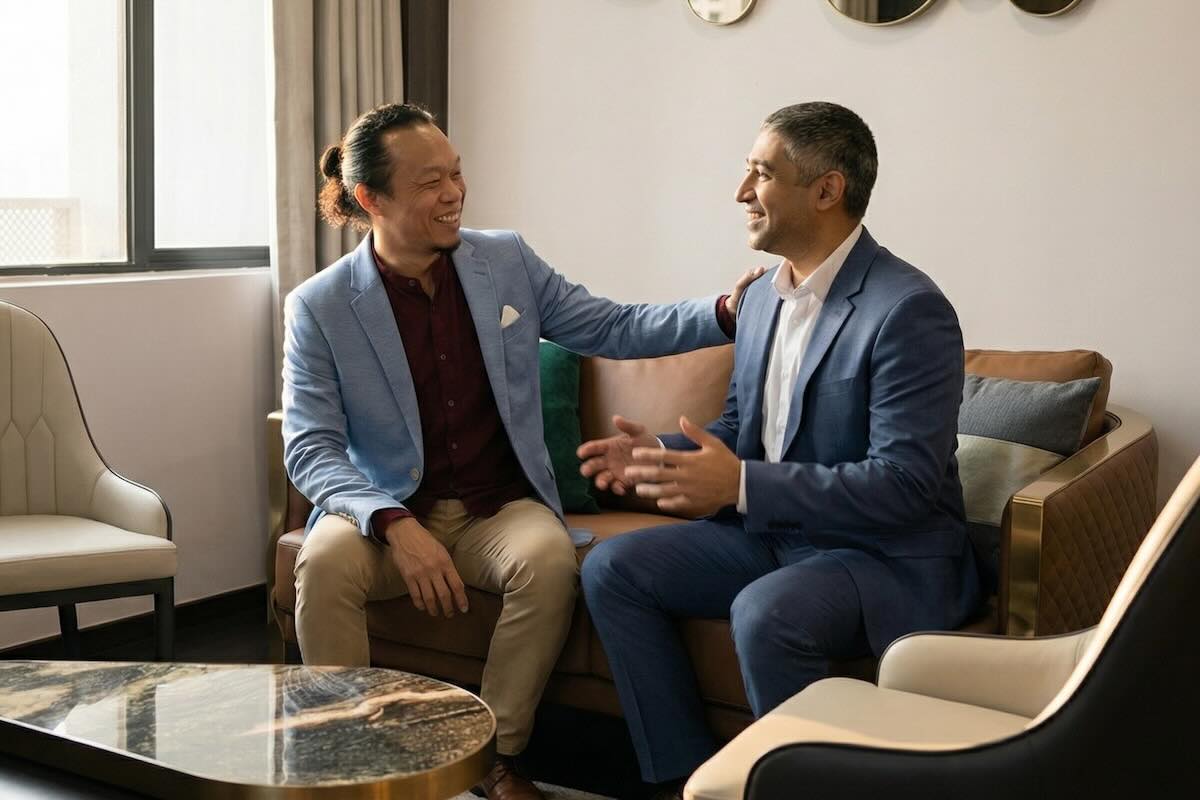
This is also where many technically-strong professionals begin to feel the true work of leadership: not about being right or efficient, but about how you take care of and steer emotions. Your ability to recognise, stay with, and respond to emotional dynamics determines whether you are perceieved as a leader others feel safe with, or guarded against.
FOR A FREE PRE-CONSULT

I had challenges with communication due to mental barriers. Working with Ellery, I felt these barriers break down, and a new way of being opened up. A truly liberating experience. I’ve even gotten a promotion!
Before coming to Ellery, I had challenges with communication due to mental barriers which resulted in much undue stress. Throughout the months working with Ellery, I felt these personal mental barriers slowly break down, and a new way of being opened up for me. A truly liberating experience.
Ellery has a great gift of coaching, using both individualized and practical approaches to give you tools to make changes in your life. He employs active listening and empathy to allow him (and yourself) to uncover barriers in yourself, giving your mind clarity and opening up possibilities that you can work on.
Coupled with practical somatic approaches, you learn to use your body to change your thoughts on the go which I used daily in both my work and personal life. I’ve even shared it to many of my friends and they have found it useful too.
Thank you Ellery – as testament to the work he’s done, I’ve even gotten a promotion!
Effective Leaders Are Emotionally-Adept
I hope you can see how keeping emotions out at the workplace is a misconception that can seriously impede your leadership. Emotions are a natural and integral part of a healthy human being, and acknowledging them is the first step to improving your ability to communicate and lead effectively. You can learn to become more aware of emotions, both in yourself and in others, which is something that can be practically-achieved through ontological coaching.
If you wish to learn these skills, the privacy and safety of 1-on-1 executive coaching in Singapore can be highly beneficial.










FOR A FREE PRE-CONSULT
What coaching is
Coaching is a form of super-customised learning, focused solely on your needs. It is one of the most dignified forms of professional help, because you choose the topic, direction and depth of what you wish to work on.
In fact, my clients are NOT ‘broken’ in any way. They are capable, creative and self-initiated individuals who want to live out their full potential. Many of them are high-performers at their workplace.
They just want support to help them hit their objectives more quickly and with less pain.
If taking ownership of your growth appeals to you, coaching is might be suitable for you.
WhatsApp me now, to accelerate your leadership journey.
"Yesterday I was clever, so I wanted to change the world. Today I'm wise, so I am changing myself."
~ Rumi