

In your quest to improve your interpersonal communication skills, you would have considered a communication workshop. With its interactive and participatory nature, workshops have long been recognized as a highly-practical learning modality. Unlike attending a class, workshops encourage active engagement, personal clarity, and hands-on learning. But what if we could have the benefits of a communication workshop in 1-on-1 communication coaching as well?
It’s not a stretch to imagine. Think of 1-on-1 communication coaching as a communication workshop that’s personalised just for you (i.e. designed for an audience of ONE). Further below are the detailed parallels between a workshop and 1-on-1 coaching, for the purpose of cultivating better interpersonal communication skills.
⚠️ Why Do You Want to Attend a Communication Workshop?
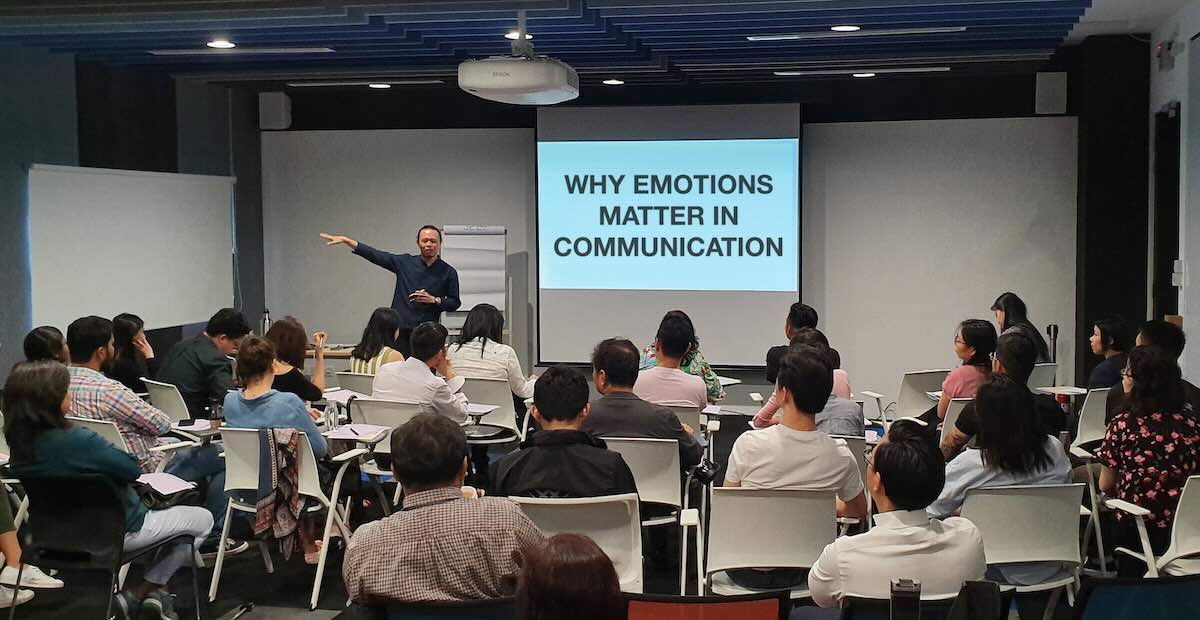
First, it’s useful to get clear on why you would want to attend a communication workshop. Based on what I’ve encountered among my clients, the most common pain points are:
① “People tell me they don’t understand what I’m trying to say.”
② “People say I’m beating around the bush, and asks me to ‘get to the point’.”
③ “People comment I’m too quiet, and tells me to speak up more.”
④ “People don’t acknowledge, or ignore my verbal contributions.”
⑤ “People say I’m too emotional, too harsh or too blunt.”
⑥ “It’s a challenge to express or assert my ideas in front of a group.”
If these sound like your real-life experience, your boss, colleagues – or even HR – might say that your critical core skills need to be improved. This becomes even more important if you want to better your chances at career progression.
Crucial Differences Between a Communication Workshop & 1-on-1 Communication Coaching
Hence, this is where it will benefit you to distinguish between a communication workshop and 1-on-1 communication coaching. Most of us are familiar with the idea of picking up new skills and knowledge through workshops or training programmes. This is what rank-and-file employees will experience.
A communication workshop, by design, must cater to the masses. It delivers general frameworks, shared exercises, and broadly applicable techniques. This is useful – especially earlier in one’s career.
However, as you climb (or aspire to climb) higher into leadership, 1-on-1 coaching tends to become more effective. This is because the demands placed on an executive or senior professional are no longer solved by mass learning. At that level, the challenges you face are far more unique.
You are not just learning what to say. You are grappling with how you show up when the stakes are high – when your voice tightens, when your mind blanks, when your presence shrinks in front of authority or conflict. These are not problems that sit purely at the level of skills or knowledge. They are deep-rooted intrapersonal patterns. You are unique, in how:
- you hesitate before speaking
- you second-guess your authority
- you manage (or avoid) tension in the room

To change such patterns, you require 1-on-1 communication coaching that is tailored to you. Working with a trusted coach provides space to look deep into your own nervous system, your own habits of thinking, and your own emotional responses in real situations, so you grow awareness to act more intentionally.
Which is why as you climb higher, 1-on-1 coaching is needed to target the unique blindspots and potential in the way you communicate. Instead of learning about communication, you begin working directly on your own communication – in your real contexts, with your real triggers, and towards outcomes that matter specifically to you as an executive.
This is the shift:
From mass learning → to precision work
From generic skills → to intrapersonal transformation
From knowing what to do → to being able to actually do it when it counts

⚠️ Which Is Suitable for You?
A Communication Workshop, or 1-On-1 Coaching?
| WORKSHOP | 1-ON-1 COACHING |
| Fixed curriculum. | Follows what’s going on in your real-life situation. |
| Suitable for the most common needs. | Customized to your specific challenges & personality |
| Trainer’s attention is divided across many students. | Coach gives 100% attention to you. |
| Teaching is front-loaded & delivered within a short time. | Learning unfolds over time, adjusting to the real situations & needs of your life. |
| Trainer spends the course duration delivering the lesson. | Coach spends the duration helping you to uncover your own blindspots & solutions. |
| Knowledge is the main product. | Progress is the main product. |
| Needed for rank-and-file productivity | Catered to leadership development |
The above characteristics are the classic differences between most ‘teaching’ modalities (workshops, trainings and courses) and 1-on-1 coaching. You will see this in 90% of cases. There could be variations, depending on the style of the professionals, as well as the business models they operate on. If you are looking to work on communication and/or confidence challenges, consider which of these modalities are suitable for you.
What If a Communication Workshop Could Be Personalized For You
Facilitating workshops was something I used to do in the earlier part of my career. While they were generally useful for helping the group find clarity and devise next steps, I was constantly finding ways to cater to each of the individuals as much as possible. When I contrast a communication workshop against 1-on-1 coaching, the following 4 differences come to mind:

1. Personalised attention
Unlike a communication workshop, 1-on-1 coaching provides individualised focus. This ensures that all content, exercises, and discussions are directly relevant to your communication needs.
2. You co-create the experience
A communication workshop is led by the trainer and the lesson plan – you follow it, whether it fits you or not. 1-on-1 coaching, however, is like a workshop for one. You set the direction, pace, and depth. Your coach facilitates, while you actively engage, bring your real challenges, and shape the trajectory of the work.
3. The learning follows your reality
In a communication workshop, learning is often front-loaded within a day or two, and designed for a generic audience. You may gain useful concepts, but applying them to your life is left to you. In 1-on-1 coaching, the work is grounded in your actual reality and evolves with you over time. We work on your upcoming conversations, the meetings you just struggled through, and the situations where your communication broke down. As you progress, the coaching adjusts to your evolving needs.
This means your learning is not theoretical or one-off. It is continuous and responsive to your real-life progress.
4. Safety
In a typical communication workshop, learning tends to stay at surface-level, except for a few courageous individuals. In a 1-on-1 setting, you have the safety to go deeper into your personal challenges and unlock more effective ways of communicating. Many of these challenges are emotional in nature, and require the privacy and confidentiality that coaching provides.

"I’ve seen a noticeable improvement in how I communicate, which has strengthened my ability to influence others & build trust in the workplace."
Ellery offers deeply personalized, ultra-tailored, and highly targeted coaching sessions that blend his unique mix of roleplay and guided exercises.
I came to him because I was having persistent troubles at work. I was struggling to relate to colleagues, with getting my point across, and to break out of a loop of frequent disagreements and long, unproductive conversations. He has been an invaluable sounding board, consistently pointing out unhelpful mindsets and nudging me toward small but meaningful shifts that make a real difference.
Over the past year I’ve worked with him, I’ve seen a noticeable improvement in how I communicate, which has strengthened my ability to influence others and build trust in the workplace.
If you’re having trouble communicating and all the books and articles still haven’t given you actionable, effective strategies, I can’t recommend Ellery enough.
How 1-on-1 Coaching is Essentially a Communication Workshop Designed for One
Now, as a communication and confidence coach, I consistently experience parallels to the same 4 characteristics when I work with my clients. I might even say a coaching session is essentially a communication workshop – for an audience of ONE!
1. Client-Centric Approach
One-on-one coaching places the client at the centre. The process is tailored to your specific goals, challenges, and needs – ensuring that every part of the journey is relevant to your unique situation.
2. Empowerment Through Self-Direction
You are not a passive recipient of advice. You actively steer the direction, pace, and depth of the work. By setting goals, identifying areas for improvement, and working collaboratively with your coach, you take ownership of your growth.
3. Reality-Based, Tailored Feedback
The work is grounded in your real-life situations. Strategies and feedback are not generic – they are specific, immediate, and directly applicable to the conversations, meetings, and challenges you are actually facing.
4. Continuous, Adaptive Progress
Unlike workshops that front-load learning within a short period, coaching unfolds over time. As you progress, the focus adjusts to your evolving needs, challenges, and goals. This allows for deeper integration – so change is not just understood, but embodied and sustained.
Who You Work With Matters
The transformational power of 1-on-1 coaching in honing interpersonal communication skills is undeniable. It’s a process that places the client in the driver’s seat, harnessing their intrinsic motivation and personal objectives. As this article has revealed, a 1-on-1 coaching format is essentially what a communication workshop designed for an audience of one could be – and more! The tailored attention, client-led journey, and customized growth opportunities combine to create an immersive experience that supercharges communication skills. But ultimately, whichever modality you choose to go with, who you work with matters.
How I Can Help You Improve Your Communication Through 1-on-1 Coaching












I can help you improve your communication and reclaim your confidence at work. This is familiar territory I’ve visited with clients on over the years, as a full-time communication coach, specializing in communication and confidence.
Every coaching engagement is unique, because each client has different needs, weaknesses and strengths. However, there are processes that unfold every single time:
- Through open exploration and in-depth reflection, we will uncover your blindspots.
- Once you can see the cause or nature of your issue, you might also be able to see how you can do things differently so you get different result.
- I can also guide you to try new ways of saying or doing things, that are effective and feel authentic for you.
- Together, we will co-create practices that you can adopt, to assimilate what you learn into your regular way of being.
- I will provide you with honest feedback which you can use to calibrate and fine-tune your new skills.
What coaching is
Coaching is a form of super-customised learning, focused solely on your needs. It is one of the most dignified forms of professional help, because you choose the topic, direction and depth of what you wish to work on.
In fact, my clients are NOT ‘broken’ in any way. They are capable, creative and self-initiated individuals who want to live out their full potential. Many of them are high-performers at their workplace.
They just want support to help them hit their objectives more quickly and with less pain.
If taking ownership of your growth appeals to you, coaching is might be suitable for you.
WhatsApp me now, to find out how you and I can work together on your communication and confidence.
Or, if you know what you want, and would like to move things along more quickly, you can pre-book a ‘chemistry’ coaching session with me → here. I will respond to you to confirm the session.
"A good coach can change the game. A great coach can change a life."
~ John R. Wooden